
MY 100-Day English -49
The explosive growth of artificial intelligence calls for rapidly increasing computing power. Two reported photonic (光子晶体) processors could meet these power requirements and revolutionize artificial-intelligence hardware.
Continuous
In the past few decades, great success has been attained in optical-fibre communication. However, it remains challenging to use photons for computing, especially at a scale and performance level comparable to those of state-of-the-art (最先进的;已经发展的) electronic processors. This difficulty arises from a lack of suitable parallel-computing mechanisms, materials that permit high-speed nonlinear (complex) responses of artificial neurons and scalable photonic devices for integration into computing hardware.
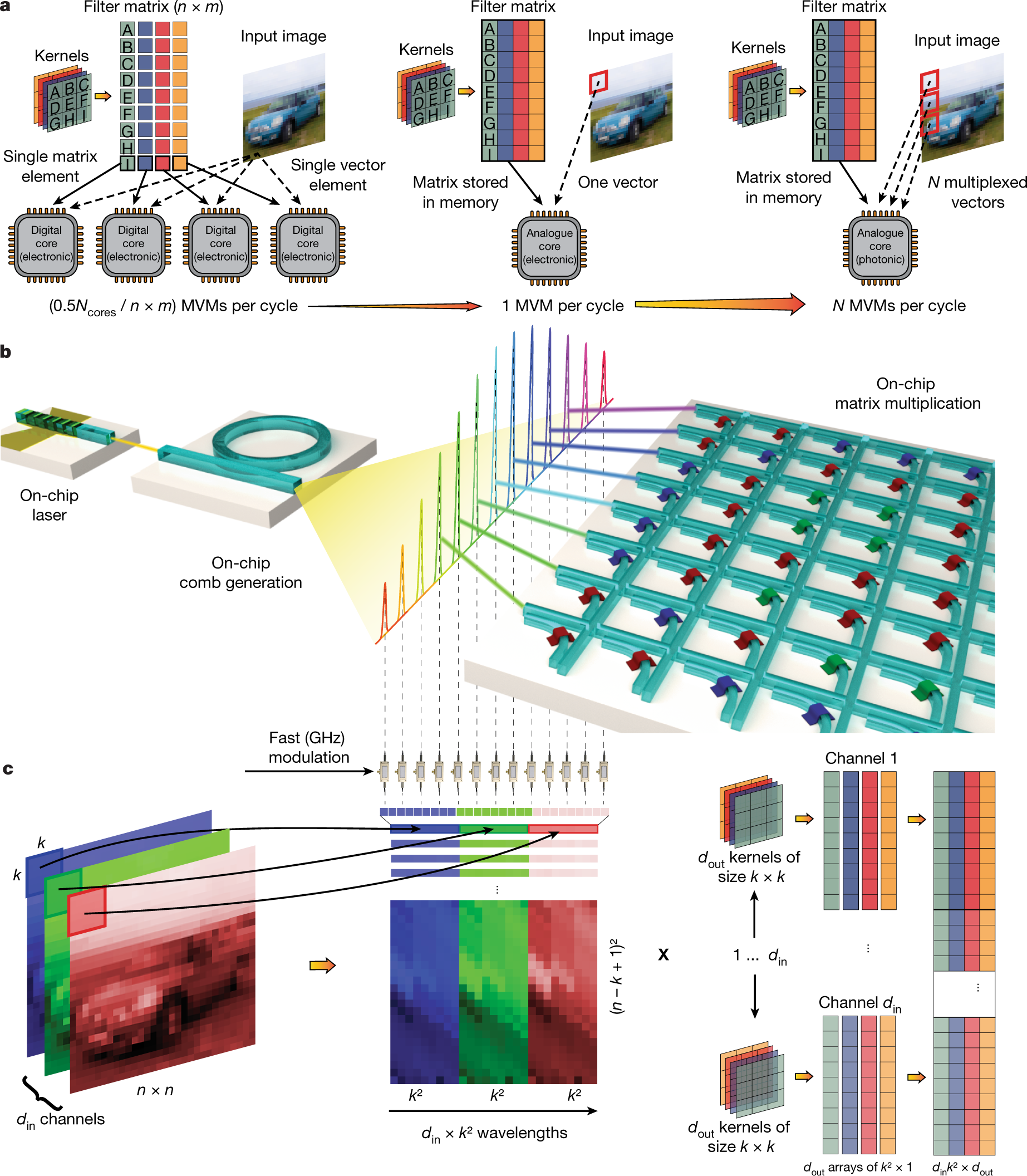
Fortunately, developments over the past few years in devices called optical frequency combs (光学频率梳)9 brought new opportunities for integrated photonic processors. Optical frequency combs are sets of light sources with emission spectra that consist of thousands or millions of sharp spectral (光谱) lines that are uniformly and closely spaced (密集的,间距小的) in frequency. These devices have achieved substantial (大量的,实质的,内容充实的) success in various fields, such as spectroscopy (光谱学), optical-clock metrology (度量,衡量) and telecommunication, and were recognized with the 2005 Nobel Prize in Physics. Optical frequency combs can be integrated into a computer chip9 and used as power-efficient energy sources for optical computing. This system is well suited for data parallelization (并行计算) by wavelength multiplexing (波长复用).
Xu and colleagues used such a set-up (设置,装置) to produce a versatile (通用的,万能的) integrated photonic processor. This device performs a type of matrix–vector multiplication (矩阵-向量乘法) known as a convolution (卷积,盘绕) for image-processing applications. The authors implemented an ingenious (有独创性的;机灵的,精制的) method to carry out (执行,实现) the convolution. They first used chromatic dispersion (光的色散) — whereby the speed of transmitted light depends on its wavelength — to produce different time delays for wavelength-multiplexed optical signals. They then combined these signals along the dimension associated with the wavelength of the light (他们沿着与光的波长相关的维度组合这些信号).
By fully exploiting the wide range of photon wavelengths, Xu et al. achieved intrinsically parallel computing for different convolution operations. The optical-computing speed was beyond ten trillion (万亿) operations per second using a single processing core and was limited only by the data throughput. Another welcome feature of this work is that the authors identify the entry point of their photonic convolution processor in practical applications. In particular, they suggest that the processor could be used in a hybrid optical–electronic framework, such as for in situ (原位) computations during optical-fibre communications.
See you tomorrow
 微信
微信 支付宝
支付宝